Tuesday, August 18, 2020

Freshwater Microflora- Freshwater Microbial Diversity


Freshwater environments provide excellent habitats for microorganisms. Large numbers of microorganisms in a body of water generally indicate high nutrient levels in the water. Water contaminated by inflows from sewage systems or from biodegradable industrial organic wastes is relatively high in bacterial numbers. Freshwater environments are highly variable in the resources and conditions available for microbial growth. Both oxygen producing and oxygen consuming organisms are present in aquatic environments, and the balance between photosynthesis and respiration controls the natural cycles of oxygen, carbon, and other nutrients (nitrogen, phosphorus, metals).


Neuston

Neuston is the uppermost layer of hydrosphere-it is the interface between hydrosphere and atmosphere and is occupied by phototrophic microorganisms. Organisms float on the top of the water -(Epineuston) or live right under the surface - (Hyponeuston).  

Primary producers are abundant here because of the availability of unrestricted light, carbon dioxide & mineral nutrients. Secondary producers also proliferate here. Microbial numbers in the surface layer are 10 to 100 fold higher than the underlying water column. Bubbles arising from the neuston layer burst out liberating bacteria and other microorganisms to air.  

Autochthonous (native) neuston microbiota include algae, bacteria, fungi and protozoa. Common bacteria are Pseudomonas, Caulobacter, Achromobacter, Flavobacterium, Alcaligenes etc. Gram positive and negative, pigmented and non-pigmented, motile and non-motile, rod and cocci, stalked and un-stalked forms seen. Common blue green algae or Cyanobacteria include Anabaena & Microcystis. Filamentous fungi like Cladosporium and various yeasts, algae like Nautococcus, Chromulina, and protozoa like Vorticella, Arcella etc. are present in neuston.


Other Freshwater Microflora           


A variety of microorganisms live in fresh water. The region of a water body near the shoreline (the littoral zone) is well lighted, shallow, and warmer than other regions of the water. Photosynthetic algae and bacteria that use light as energy flourish in this zone. Further away from the shore is the limnetic zone. Areas of the limnetic zone with sufficient oxygen contain bacteria like Pseudomonads and species of Cytophaga, Caulobacter, and Hyphomicrobium. Photosynthetic algae are also located in the limnetic zone. 

Deeper waters of the profundal and benthic zones have low oxygen concentrations and less light. Algal growth near the surface often filters the light, and photosynthetic microbes in deeper zones  use different wavelengths of light from those used by surface-layer photosynthesizers. Purple and green sulfur bacteria are found in the profundal zone. These bacteria are anaerobic photosynthetic organisms that metabolize H2S to sulfur and sulfate in the bottom sediments of the benthic zone. Finally, at the bottom of fresh waters is the benthic zone containing the sediments, where few microbes survive. Bacteria that can survive in the absence of oxygen and sunlight, such as methane producing bacteria, thrive here. Clostridium species are common in bottom sediments and may include botulism organisms, particularly those causing outbreaks of botulism in waterfowl. 

Microbial photosynthesizers mainly include algae and cyanobacteria . Others feed on these organisms, forming the next link in the food chain . Plant material from the land also enters lakes and streams at their edges, providing an important nutrient source for many water bodies. Decomposers form an especially important part of fresh-water ecosystems because they consume dead bodies of plants, animals, and other microbes. These microbial agents of decay are an important part of the ecosystem because they convert detritus (dead and decaying matter) and organic materials into needed nutrients, such as nitrate, phosphate, and sulfate. Decomposers  are essential to the major biogeochemical cycles by which nutrients are exchanged between the various parts of the ecosystem, both living and nonliving.

 Aerobic decomposers in water need oxygen to survive and do their work which is ensured by the flowing water and waves. If there is not enough oxygen in the water, many parts of the system suffer-the aerobic decomposers cannot digest plant matter, insects cannot develop and mature, and the fish cannot grow properly. Eventually, the stream or pond will be changed, starting at the microbial level. Human interaction can jeopardize parts of this system in a variety of ways.

Fresh water is host to numerous microorganisms that affect human health directly.  Polluted drinking water is a major source of illness and death throughout the world, particularly in developing countries. Some common microbes in lakes and streams that are responsible for disease include:

  • The protozoa Giardia lamblia, found in fresh-water bodies throughout the world. Giardiasis is a common waterborne illness.
  • The bacterium Vibrio cholerae, remains a significant source of disease and death .
  • The bacterium Escherichia coli, is a very common waterborne pollutant. Humans have a large and harmless population of E. coli in their large intestines, and bacteria make up a large fraction of the volume of human feces. When released into drinking water or recreational water sources, E. coli can be ingested causing diarrhea. 

Thus, many microorganisms are found naturally in fresh water including bacteria, cyanobacteria, protozoa, algae and tiny animals such as rotifers. These can be important in the food chain that forms the basis of life in the water.


Monday, August 17, 2020

Bio Prospecting - Introduction

Bio prospecting or biodiversity prospecting is the exploration of microorganisms, wild plants and animals for commercially valuable genetic and bio-chemical resources.

In many cases, bio prospecting is a search for useful organic compounds in microorganisms, plants and fungi that grow in extreme environments such as rainforests, deserts and hot springs.

Humankind has been studying, manipulating and exploiting natural diversity ever since the emergence of Homo sapiens over 150,000 years ago. Our early ancestors explored biodiversity and learned how to derive benefits from nature.

Early bio prospecting led to the improvement of methods for growing food, building shelters and maintaining health. Modern-day bio prospecting is simply an extension of our long history of exploring nature to improve the quality of our life.

Most of the raw materials for biotechnology oriented industry comes from the wild rainforests of the southern hemisphere. For example, many scientists believe that the cures for AIDS, cancer and other diseases lie hidden in these green vegetation.

The main objectives of bio prospecting are to fulfill economic and conservation goals and to enhance medical and agricultural advances needed to combat disease and sustain a growing human population.  Agencies- scientific and corporates, use the folk wisdom of indigenous people to locate and understand the use of medicinal plants. Then this knowledge is commercially exploited. There needs a partnership between business men, academicians and with indigenous people to effectively utilise the ‘green gold’ (the plants and animals with properties which businesses could use for new products and services) of bio prospecting.

Academic Work and Bio Prospecting- Case of Taq Polymerase:

Dr. Thomas Brock (1966) studied microorganisms living in yellow stone’s hot springs. He named one of the curious microorganism he isolated Thermus aquaticus. This microorganism lives and thrives in water so hot that it would kill an ordinary animal. Dr. Brock grew Thermus aquaticus in the laboratory and gave a living sample to the American Type Culture Collection for safe keeping. Dr. Brock’s work was an academic one.

In 1985, a biotechnology company named Cetus Corporation was developing a new way to duplicate genetic material. Dr. Kary Mullis, working at Cetus corporation invented a way to duplicate DNA, called Polymerase Chain Reaction (PCR).

But the high temperatures required by PCR destroyed the polymerase enzymes and fresh enzymes had to be added throughout the PCR process. Scientists at Cetus isolated an enzyme, named Taq polymerase, from Thermus aquaticus, which can withstand high temperatures of PCR process. PCR using Taq polymerase was so effective that a whole new scientific field has flourished as scientists finally had a convenient way to study DNA.

Thus, Dr. Brock’s academic work in Yellow stone had a practical application that he never imagined in his academic career.


Microorganisms in freshwater system- streams & rivers, wetlands, ice

  • Streams and Rivers

Streams and rivers are a different from lakes due to the presence of flowing waters. They have zones of rapid water movements and pools of reduced currents. Rocky substrates underlie the rapid zones. In pool zones deposition of silt is seen due to decreased current velocity. Rivers are closely connected with lithosphere along its banks and there is constant transfer of substances through rain water runoff and erosion of river banks. 

Upper course of a river has swift flow, high degree of oxygenation and low temperature. Primary production is low due to shading by trees and the organic material input occurs mainly from lithosphere. Middle course of river has low flow velocity, huig temperature, less shading and significant primary production. Lower course has high levels of silt depositions, is subject to tidal influences, and is inhabited by less of freshwater microbes and more of salt-tolerant estuarine microorganisms.

Microbial organisms in rivers are seen attached to submerged rocks and other structures. Dissolved nutrients are rapidly absorbed by them and liberated upon their death and decay. These are then reabsorbed at a little distance downstream. Thus the nutrients do not move swiftly along with the water flow. Rather nutrient spiraling is seen where it is absorbed, released and then moves little downstream again to be absorbed, thus completing a cycle.

Nutrient spiraling

Rivers receive high amounts of effluents from industries and municipalities. High amounts of organic compounds are released which can lead to depletion of available oxygen since it is used in microbial decomposition of these organic compounds. Industrial effluents may contain toxic heavy metals, which affect microbial life and activities. Agricultural runoff containing chemical toxins or fertilizers can either harm or cause proliferation of microbial communities.

Thus, in rivers and streams, there is more of horizontal water movement and most of the functional microbial biomass is attached to surfaces. Depending on the size of the stream or river, the source of nutrients may vary. The source may be in-stream production based on photosynthetic microorganisms. Nutrients also may come from outside the stream, including runoff sediment from riparian areas (the edge of a river), or leaves and other organic matter falling directly into the water. Chemoorganotrophic microorganisms metabolize the available organic material and provide an energy base for the ecosystem.

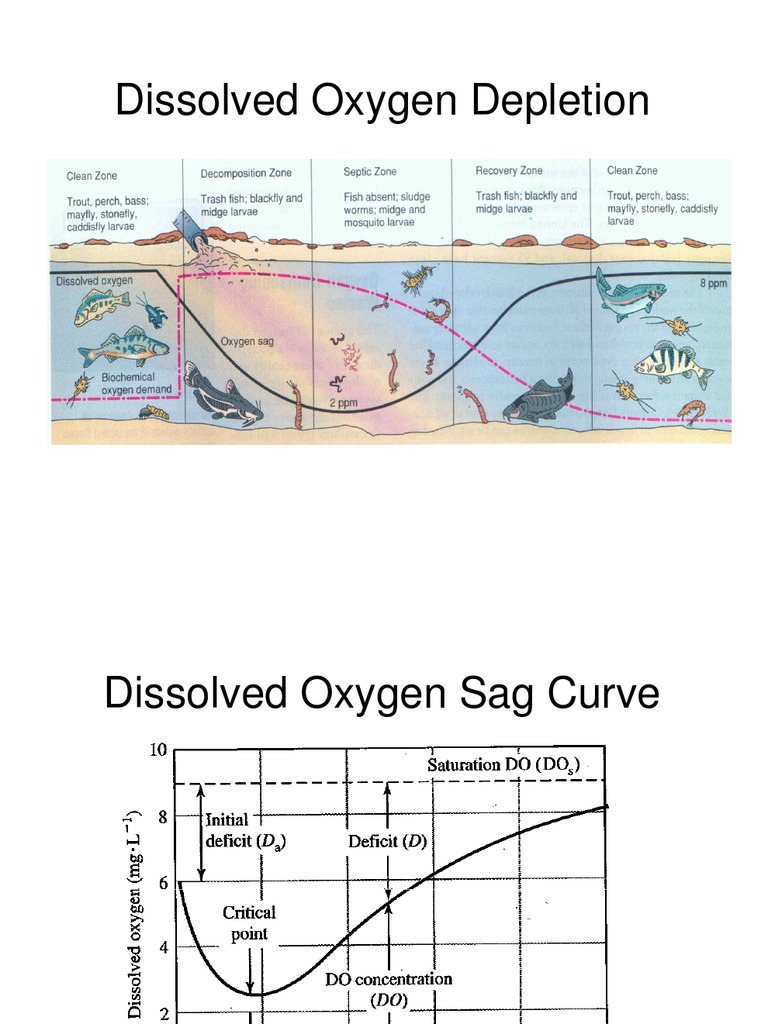
Under most conditions the amounts of organic matter added to streams and rivers will not exceed the system’s oxidative capacity and productive, aesthetically pleasing streams and rivers will be maintained. The capacity of streams and rivers to process such added organic matter is, however, limited. If too much organic matter is added, the water may become anaerobic. This is especially the case with urban and agricultural areas located adjacent to streams and rivers. The release of inadequately treated municipal wastes and other materials from a specific location along a river or stream represents a point source of pollution. Such point source additions of organic matter can produce distinct and predictable changes in the microbial community and available oxygen creating an oxygen sag curve.  Runoff from fields and feedlots, which causes algal blooms in eutrophic water bodies, is an example of a nonpoint source of pollution. 


The Dissolved Oxygen Sag Curve.

Dissolved Oxygen Sag Curve- Microorganisms and their activities can create gradients over distance and time when nutrients are added to rivers. When organic wastes are added to a clean river system, there are changes in dissolved oxygen levels and amount of aquatic life. During the later stages of self-purification, the phototrophic community will again become dominant, resulting in diurnal changes in river oxygen levels.

           When the amount of organic matter added is not excessive, the algae will grow using the minerals released from the organic matter. This leads to the production of O2 during the daylight hours, and respiration will occur at night farther down the river, resulting in diurnal oxygen shifts. Eventually the O2 level approaches saturation, completing the self-purification process.

Along with the stresses of added nutrients, removal of silicon from rivers by the construction of dams and trapping of sediments causes major ecological disturbances. The decreased silicon availability inhibits the growth of diatoms because the ratio of silicon to nitrate has been altered (silicon is required for diatom shell formation). With this shift in resources, diatoms are not able to grow and immobilize nutrients. There may be an increase in nitrate levels and a massive development of toxic algae. Thus the delicate balance of rivers can be altered in unexpected ways by dams, leading to effects on aquatic microbiological processes and whole ecosystems. With the damaging effects of dams now being recognized, there are attempts to stop constructing more and to restore normal water and sediment movements. This also allows fish migration into upper regions of rivers where they often have been excluded for decades.

  • Wetlands

Shallow aquatic environments with plants dominating. Depending on the kind of plants

·         Freshwater marshes- grassy plants dominate reeds, cattails etc

·         Fens- mineral rich wetlands, neutral to alkaline pH; contain sedge plant

·         Shrub-carrs- dense growth of willows, birches

·         Swamps with coniferous/hardwood trees

                    Shrub -carr
Marsh
                                                                Fen with sedge plants
                                                                    Swamp

    High productivity is seen but waterlogging and oxygen limited conditions inhibit biodegradation of plant polymers especially lignocellulose resulting in accumulation of plant residues. Accumulated plant residues can be transformed geochemically to form coal or peat.

Bogs are a kind of wetlands. Dominant plant is sphagnum moss which form a thick mass. Less productive than other wetlands. Sphagnum moss holds water effectively resembling a water soaked sponge. As its height increases by accumulation of peat,  it is isolated from the soil and bedrock and cannot receive nutrients from running water. It becomes ombrotrophic-cloud nourished (nutrients form atmosphere and rain).


  • Freshwater Ice

Fresh waters include glaciers, as well as vast ice sheets in the Arctic and Antarctic polar regions. These regions, although far away from most people, are important as habitats for microorganisms. Of particular interest are deep frozen lakes in the Antarctic region. An excellent example is the McMurdo Dry Valley Lakes, which have 3 to 6 meter thick ice layers with windblown sediments occupying various levels in the ice profile. In the summer, melting of the ice in these sediment-containing zones provides an opportunity for microbial growth. There is interest in studying ice-inhabiting microorganisms from the north and south poles.

One of the most interesting deep-frozen habitats lies above Lake Vostok in the Antarctic, where cores are at a depth of 3,600 meters (11,800 feet) in ice that has been frozen for over 420,000 years. The actual Lake Vostok lies below another 120 meters of ice. Scientists are actively searching for microorganisms in these unique older freshwater frozen environments.


Sunday, August 16, 2020

Penicillin Fermentation - Introduction

 Antibiotic - defined by Selman Waksman as

“an organic compound produced by one microorganism that, at great dilutions, inhibits the growth of or kills another or even group of other harmful microorganisms”

Antibiotics are available in various forms- ointment, powders, capsules, etc. For example, to treat bacterial infection on the surface, an antibiotic should be there in an ointment or cream form.  But to treat internal infection it can be directly injected into the bloodstream which finally distributed throughout the body.

Antibiotics are produced primarily by bacteria, Streptomyces, Nocardia and fungi. Antibiotics produced by Streptomyces spp. (Streptomycin, Neomycin etc..) have the most commercial applications.

On the basis of mode of action antibiotics are divided into

i) Antibiotics affecting cell wall 

ii) Antibiotics damaging cell membrane 

iii) Antibiotics interfering with protein synthesis

iv) Antibiotics inhibiting nucleic acid synthesis

v) Antibiotics blocking cell metabolism

The first discovered natural antibiotic was Penicillin by Alexander Fleming. Penicillin was obtained from “Penicillium notatum”.


History 

In 1928, Sir Alexander Fleming made one of the most important contributions to the field of antibiotics. 

 He first observed the antibiotic properties & therapeutic value of penicillin.

In an experiment, he observed that air born contaminant, later shown to be Penicillium notatum, inhibited the growth of a culture of S. aureus on an agar plate.  He called this material Penicillin after the mold that had produced it. In 1932, he published paper, which proposed a method for use of penicillin in treatment of infected wounds.

 But early samples of penicillin were not purified, and further refinements were needed. 

Howard Florey, Ernst Chain and associates purified Penicillin in the 1940s. 

Later on, different scientists worked in on different aspects of Penicillin and their production on large scale which helped launch the modern antibiotics industry. 


The World War II had brought a demand for penicillin on a large scale for the treatment of burns and wounds.


By the end of the war (late 1943), many drug manufacturing companies started mass production of  Penicillin.

In 1945 Fleming, Florey and Chain were awarded the Nobel Prize in Physiology and Medicine.


Mode of action: Penicillin is active against many Gram positive bacteria, Nocardia, and Actinomycetes, but not against most Gram negative bacteria except at higher dosage level. It interferes with cell wall synthesis of actively growing sensitive organisms. It mainly inhibit the cross linking steps of peptidoglycan synthesis in the cell wall.

Penicillin

Penicillin is a group of compounds having common basic nucleus, 6-amino penicillanic acid (6-APA).  6-APA contains ring like structure termed as a β-lactam ring.


Penicillin

Penicillins are of two different types- Natural Penicillin & Synthetic Penicillin

Natural penicillin is directly harvested from the Penicillium mold. Synthetic penicillin has the basic Penicillin nucleus (6-APA), but with new side chains that provide altered properties of to the natural compound. Eg., Ampicillin, Methicillin, Penicillin

(contd..)

References

  • Principles of Fermentation Technology: (2nd edition, by Peter F. Stanbury, Allan Whitaker and Stephen J. Hall, Butterworth-Heinemann, An imprint of Elsevier Science.)
  • Industrial Microbiology: (By Casida L. E.New Age international (P) ltd publications)
  • A Text Book of Industrial Microbiology: (2nd edition By Wulf Crueger & Anneliese Crueger)

Thursday, August 13, 2020

Experimental Research -Research Biases

 What is Experimental Research?

Experimental research is a study that strictly adheres to a scientific research design.

It includes a hypothesis, a variable that can be manipulated by the researcher, and variables that can be measured, calculated and compared.

Most importantly, experimental research is completed in a controlled environment.

The researcher collects data and results will either support or reject the hypothesis. This method of research is referred to a hypothesis testing or a deductive research method

What is the Purpose of Experimental Research?

Experimental research seeks to determine a relationship between two (2) variables—the dependent variable and the independent variable. After completing an experimental research study, a correlation between a specific aspect of an entity and the variable being studied is either supported or rejected.

What type of Data are Collected in Experimental Research?

Data in experimental research must be able to be quantified, or measured.

Data collected could be acidity/alkalinity, area, circumference, density, electrical current/potential/resistance, force, growth (time, weight, volume, length/width), heat, humidity, light intensity, mass, pressure, sound intensity, temperature, time, velocity, volume or weight.

However, the entity should be carefully observed qualitatively, or described using words and photographs. How does the entity look, smell, sound, feel, and taste (when appropriate)? These types of observations help supplement the measurements taken throughout the experiment.

What Types of Experiments are Considered Experimental Research Projects?

  •   Forensic Studies—Studying decomposition (an entomology study), damage to objects (a physics/engineering study), can be done in a controlled environment and be measured. eg., The Effect of _____ on_____” Studies—. All experimental studies look to determine how one thing affects another.
  •          Product Effectiveness—If a specific aspect (active ingredients, size of crucial components etc…) of several products can be determined to be in different quality or quantity, this makes for a great experimental project. (For example the different levels of Ethyl Alcohol within antibacterial hand sanitizers.)
  •        Microbiology—bacteria grow quickly, change in population is easily measured and therefore make for a good experimental study.


Research Biases We have got a hypothesis which is the first step in doing an experiment. Before we can continue, we need to be aware of some aspects of research that can contaminate our results. In other words, what could get in the way of our results in this study being accurate. These aspects are called research biases, and there are basically three main biases we need to be concerned with.

Ø  Selection Bias – occurs when differences between groups are present at the beginning of the experiment. 

Ø     Placebo Effect – involves the influencing of performance due to the subject’s belief about the results. In other words, if I believe the new medication will help me feel better, I may feel better even if the new medication is only a sugar pill. This demonstrates the power of the mind to change a person’s perceptions of reality. 

Ø    Experimenter Bias – the same way a person’s belief’s can influence his/her perception, so can the belief of the experimenter. If I’m doing an experiment, and really believe my treatment works, or I really want the treatment to work because it will mean so much for me, I might behave in a manner that will influence the subject.


Controlling for Biases After carefully reviewing a study and determining what might effect its results, we need to control for these biases.

Ø  To control for selection bias, most experiments use what’s called ‘Random Assignment’, which means assigning the subjects to each group based on chance rather than human decision.

Ø  To control for the placebo effect, subjects are often not informed of the purpose of the experiment. This is called a ‘Blind’ study, because the subjects are blind to the expected results.

Ø  To control for experimenter biases, we can utilize a ‘Double-Blind’ study, which means that both the experimenter and the subjects are blind to the purpose and anticipated results of the study.

Standardization

We have our hypothesis, and we know what our subject pool is, the next thing we have to do is standardize the experiment. Standardization refers to a specific set of instructions. The reason we want the experiment to be standardized is twofold.

First, we want to make sure all subjects are given the same instructions, presented with the experiment in the same manner, and that all of the data is collected exactly the same or all subjects.

Second, single experiments cannot typically stand on their own. To really show that are results are valid, experiments need to be replicated by other experimenters with different subjects. To do this, the experimenters need to know exactly what we did so they can replicate it.

To conclude, experiments should be objective. The views and opinions of the researcher should not affect the results of a study. This makes the data more valid, and less biased. If sufficient care is taken, experimental research is a good approach to obtain verifiable and proper results

Wednesday, August 12, 2020

Neisseria gonorrhoeae- Morphology, Cultural characteristics, Biochemical Properties

 Neisseria is the only pathogenic Gram negative diplococci 

Two species of Neisseria causes disease in humans; Neisseria meningitidis and Neisseria gonorrhoeae.


Neisseria gonorrhoeae (Gonococcus) causes the venereal disease gonorrhoea, the second most common sexually transmitted disease (STDs) of worldwide importance (Chlamydial infections are more common).


Human beings are only known hosts of N. gonorrhoeae - It causes natural infection only in humans.


Cause an acute, infectious, sexually transmitted disease of the mucous membranes of the genitourinary tract, eye, rectum, and throat - gonorrhea, neonatal conjunctivitis (ophthalmia neonatorum) and pelvic inflammatory disease (PID).


Neisseria gonorrhoeae thrives in a CO2 environment, therefore, the urethra, cervix, rectum, and throat are the main sites of infection.


 Gonococcus was first described in gonorrheal pus by Neisser in 1879.


Bumm in 1885 cultured the coccus & proved its pathogenicity by inoculating human volunteers.


Morphology:

·         Gram-negative, oxidase-positive, diplococcus (seen in pairs) – typically kidney shaped -adjacent sides concave-

·         In urethral discharge it is predominately found within the polymorphs - Intracellular - Some cells may contain as many as 100 cocci.


Urethral exudate containing Neisseria gonorrhoeae from a patient with gonococcal urethritis -typical intracellular gram-negative diplococci, and extracellular gram-negative organisms, which is diagnostic for gonococcal urethritis.

·         Nonmotile

·         Non-capsulated

·         Have pili- facilitate adhesion of the cocci to mucosal surface & promote virulence 


Cultural characteristics

  • ·         More difficult to grow
  • ·         Aerobic -may grow anaerobically also
  • ·         Growth occurring best at pH 7.2 – 7.6 
  • ·         Optimum temperature for growth – 35 - 360 C; no growth if the temperature is less than 25⁰C or more than 38.5⁰C
  • ·         Growth is good in presence of 5 -10 % CO2
  • ·         Grow well on enriched media like Chocolate Agar
  • ·         Selective medium – THAYER – MARTIN medium (contains Vancomycin + Colistin + Nystatin which inhibit most of the contaminants like nonpathogenic Neisseria).
  • ·         Small, round, translucent, convex or slightly umbonate with finely granular surface and lobate margins.
  • ·         Soft and easily emulsifiable


                                                                Thayer-Martin agar


Biochemical

  • ·         Oxidase positive (prompt positive reaction)
  • ·         Catalase positive
  • ·         Glucose  utilized with acid production, but not maltose, sucrose/lactose
  • ·         Indole  not produced
  • ·         Nitrates not reduced


(contd..)


Microbes in waste water

  Typical raw sewage has 99.9% water and 0.1% organic and inorganic solids. The following components make the sewage: ·          The organic...